













What to Do When Your AC Stops Cooling: A NYC Homeowner’s Guide
Before you call for air conditioning repair, run through these quick checks that solve many NYC cooling failures—saving you time and a service visit when the fix is simple.
Check Your Thermostat, Breaker, and Filter: The 3‑Step DIY That Solves 30% of Calls
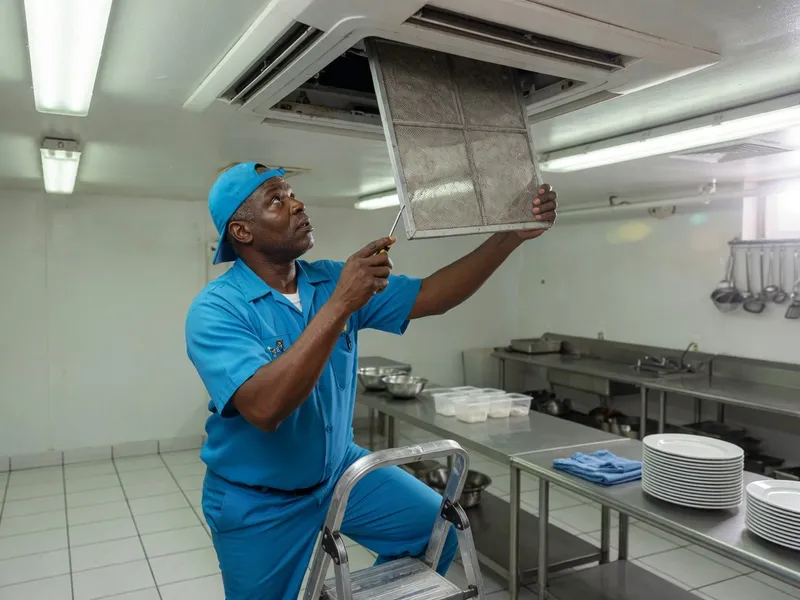
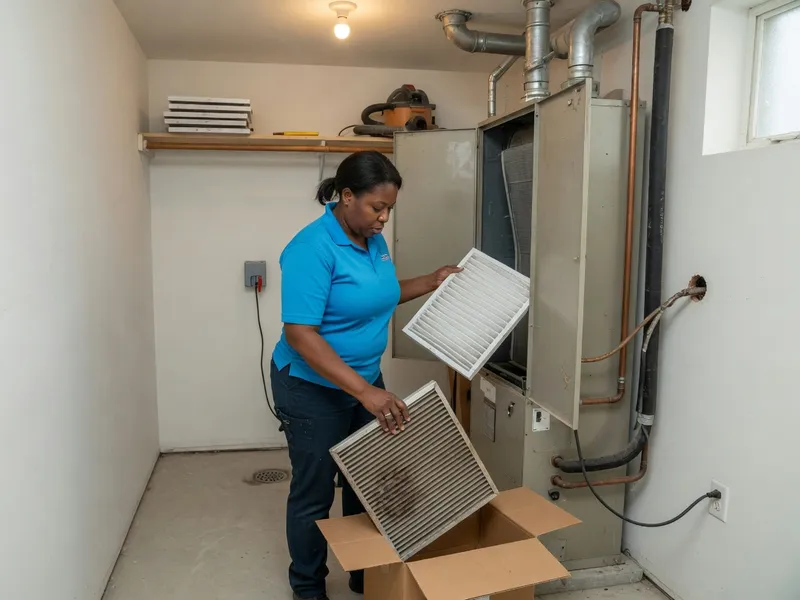
When your AC stops cooling, Eco Service NY suggests you first check the thermostat is set to “cool” and below room temperature, reset the double‑pole breaker and the outdoor disconnect box, and replace a visibly dirty filter. These three steps restore many systems in minutes—no air conditioning repair needed. In our experience, a filter black with NYC summer dust can drop airflow 30% and freeze the evaporator coil solid, cutting all cooling. The outdoor disconnect box, often located on the exterior wall near the condenser, may have been pulled by a maintenance crew or tripped by a surge; flipping it back on is a two‑second fix. A tripped outdoor disconnect alone can kill the entire unit, and homeowners often miss it because the indoor breaker wasn’t the culprit.
When DIY Isn’t Enough: Humming, Frost, and What Those Signs Mean
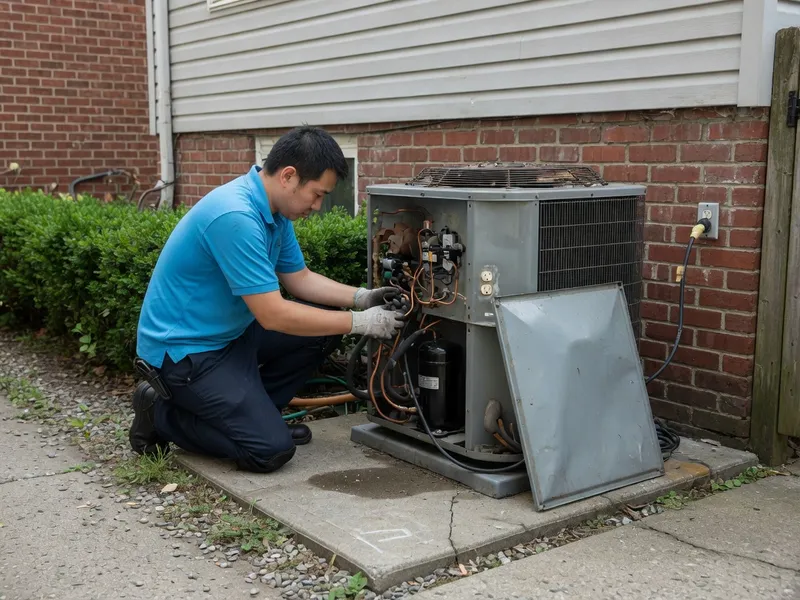
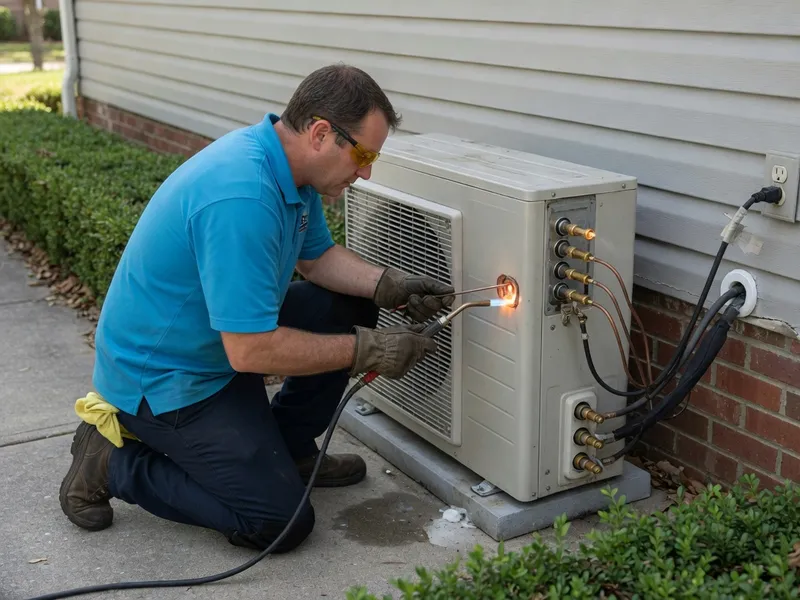
- Humming outdoor unit or iced copper line: Turn the AC off immediately—these point to a bad capacitor or low refrigerant. Eco Service NY technicians can repair both same‑day, often within 90 minutes.
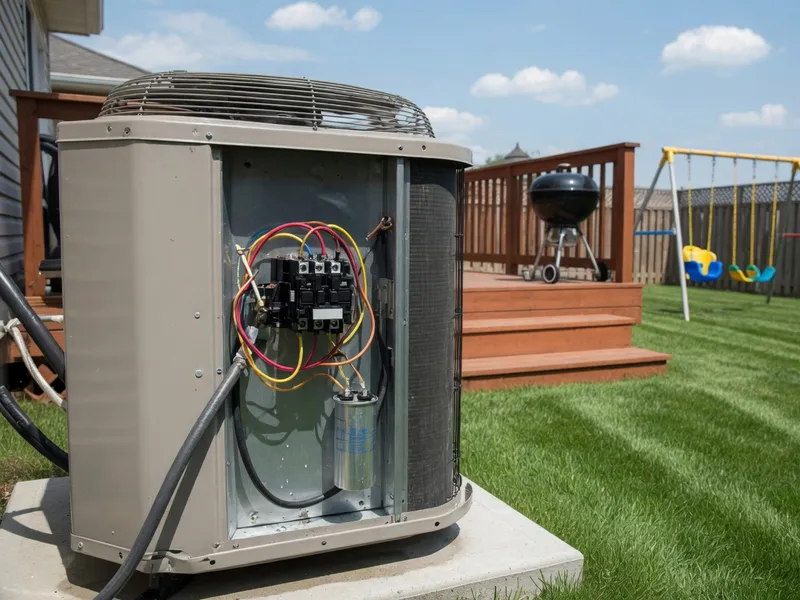
- Humming, no fan spin: A failed run capacitor can’t start the compressor; the hum is the motor trying to turn. Cut power to avoid winding burnout.
- Ice on the copper line: The evaporator is frozen from low charge or poor airflow. Do NOT run—liquid slugging can destroy the compressor.
- Critical warning: Forcing a frozen system pushes liquid refrigerant into the compressor—a $1,500 mistake. Always shut down and call for a free diagnostic with repair.
Two of the most common—and misunderstood—sources of a dead air conditioner are low refrigerant and a failing compressor. Understanding the symptoms helps you catch the issue before a minor repair turns major.
Low Refrigerant Symptoms: Frost on the Small Copper Line and Lukewarm Air
When your AC blows only lukewarm air and you spot frost on the thin suction line or the indoor coil, it almost always means the refrigerant charge is low. At Eco Service NY, we confirm with a temperature split test—less than 14°F between return and supply air indicates undercharge. You might hear a hissing or bubbling sound near the indoor unit as refrigerant escapes from a pin-hole leak in the evaporator coil. On older R-22 systems, the suction line runs ice-cold to the touch, while the liquid line stays warm—a telltale sign the expansion valve is starved. Topping off refrigerant without repairing the leak is against EPA rules for any system losing more than 10% per year—and it guarantees your problem will return within weeks.
Compressor Warning Signs: Clanking, Humming, or Repeated Breaker Trips
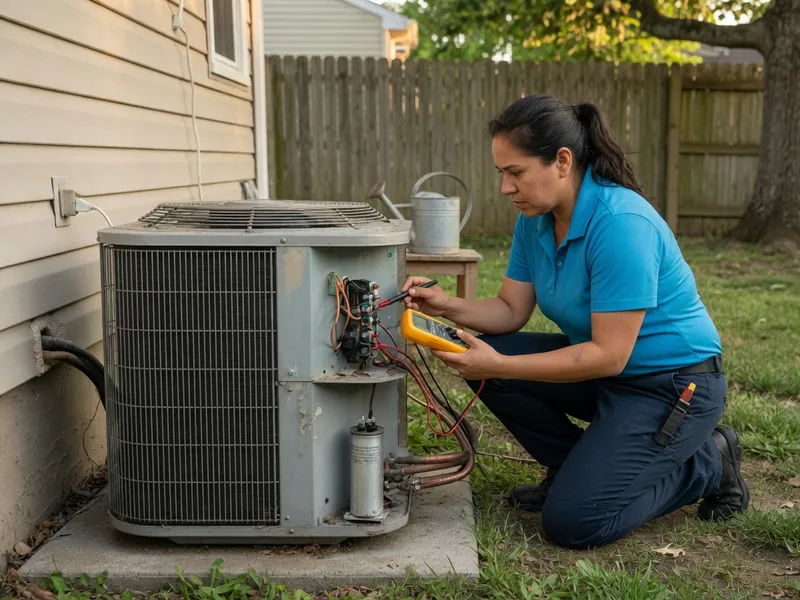
A dying compressor often gives a loud clank or rattle at startup, or it hums without starting and then trips the breaker. If the outdoor unit stays silent while the indoor fan runs, we immediately test the capacitor and compressor windings with a multimeter. A swollen or leaking start capacitor often fools homeowners into thinking the compressor is seized—the unit just hums and draws locked-rotor current until the breaker kicks. On Goodman and Rheem units we see capacitor failures in under five years, especially if the condenser coil is partially blocked with cottonwood fuzz and the head pressure rises. Misreading a bad capacitor as compressor failure costs homeowners thousands; we always check the microfarad rating first—a $150 fix vs. a $1,500 replacement.
Repair or Replace Your AC in NYC? How to Make the Right Call
Deciding between AC repair and a full replacement can feel overwhelming, especially when you’re staring at a four‑figure estimate. We walk you through the key numbers and rules of thumb that guide honest advice.
The 50% Rule: When an HVAC Repair Cost Exceeds Half the Price of a New Unit
For an hvac repair to make sense, we follow the 50% rule: if fixing your AC costs over half what a brand‑new unit would, upgrading is the smarter investment. For a typical NYC central system at $3,000–$4,000, that means any repair estimate north of $1,500–$2,000 pushes you toward an upgrade. Compressor replacement alone lands in the $800–$1,500 range, and on a 10- to 12-year-old system the SEER rating is often stuck at 10 or lower — barely half the cooling per watt of a 16+ SEER unit. That old compressor can fail again within 18 months, turning a ‘save it’ repair into good money after bad. We also calculate the 30% (or more) summer-energy savings the efficiency jump delivers, which often makes the upgrade payback quicker than owners expect.
Age, Refrigerant, and NYC Building Rules: Surprising Factors That Tip the Scale
In NYC, a 12‑year‑old R‑22 unit might be worth repairing if the compressor is still strong, but co‑op requirements can make replacement a paperwork headache. At Eco Service NY, we factor in your building’s approval process and whether the repair uses expensive phased‑out refrigerant. Swapping an R‑22 system for an R‑410A unit often requires a line‑set replacement and possibly a new evaporator coil, pushing the bill higher — but R‑22 prices keep climbing as supply dwindles. A lack of regular maintenance lets efficiency slide 5–10% each year, making repair a short‑term band‑aid if the unit hasn’t been tuned. A simple capacitor or contactor replacement at $250 can extend a system’s life two years; we’ll tell you if the numbers no longer add up.
How to Find a Trustworthy AC Repair Company in NYC (And Avoid Scams)
Not every AC repair contractor in NYC is equal. Knowing what questions to ask and red flags to spot will protect you from shoddy work and price‑gouging.
5 Questions to Ask a Prospective AC Repair Company (Before They Even Arrive)
- EPA‑608 certification? Before you book an ac repair near me, ask to see the card—any refrigerant work demands it.
- Free diagnostic with repair? We waive the fee when you hire us; others charge regardless.
- Warranty? Demand at least 1 year on parts and labor—a 90‑day guarantee is the bare minimum.
- NY DOS Home Improvement license number? A legitimate NYC firm will provide it instantly.
- Fixed upfront price? No hidden overtime or weekend charges. A refusal to show any of these can cost you $500+ in repeat call‑backs.
Why Our 365-Day Warranty and $0 Diagnostic Signal Real Confidence
Every air conditioning repair at Eco Service NY includes a 365‑day warranty on parts and labor, and we waive the diagnostic fee when you proceed—a combination that reflects how confident we are in our work. Many NYC companies only offer 90 days, leaving you exposed if the same part fails six months later. If a compressor fails at 8 months or a capacitor burns out, we cover both the part and the labor—no pro-rating, no second trip fee. In my experience, a short warranty often signals that a shop buys the cheapest after‑market parts and expects you to call back. The free‑diagnostic credit means you never pay us just to show up and give you a price—you only pay for the solution.
Smart Ways to Boost Your AC’s Energy Efficiency (and Lower NYC Bills)
Summer ConEd bills don’t have to sting. A few targeted upgrades and habits can improve your AC’s efficiency by 15–30%, often without a major investment.
Sealing Leaky Ducts: The 20% Capacity Recovery Most NYC Homes Need
In typical NYC brownstones and rowhouses, 20–30% of cooled air escapes through leaky duct joints in basements and attics. At Eco Service NY, our air conditioning repair service includes duct sealing with foil tape and mastic to recover that lost capacity. Pressurizing the ductwork with a calibrated fan reveals leaks as low as a few cubic feet per minute—we target any joint that shows visible separation or old tape peeling away. Mastic seals are flexible enough to handle thermal expansion in a pitched roof attic, unlike brittle duct tape that fails after a couple of heating cycles. You can spot a major leak yourself by feeling for drafts when the system runs, but only a pro can reach hidden runs behind finished walls.
Program Your Thermostat for Big Savings — Our Recommended NYC Settings
Setting a programmable thermostat to 78°F while you’re home and 85°F when away cuts cooling demand by up to 10%, and we can upgrade your old dial to a smart model in one visit. Our technicians also hard‑wire it to prevent short‑cycling that wears out the compressor. A smart thermostat like an Ecobee or Nest learns your schedule and can drop the setpoint automatically, but a dumb programmable unit set to a fixed schedule does 90% of the job. We hardwire the common wire to eliminate battery dependence and ensure the thermostat can call for cooling without relay chatter. Constantly lowering the temperature “just a little” forces the compressor to start and stop frequently—each cycle adds stress to the contactor and run capacitor.
What’s Included in an AC Diagnostic? Our 7-Step Process Explained
When you call us for AC trouble, the diagnostic isn’t a guess—it’s a systematic 7‑step protocol that pinpoints the fault in 30–60 minutes, backed by a written report.
Inside a Professional AC Diagnostic: Step‑by‑Step With Timelines
- Phone triage (3–5 min): When you hire an hvac contractor from Eco Service NY, the 7‑step diagnostic starts with ruling out thermostat, breaker, and power—45 minutes total.
- Visual check (10 min): We inspect the filter, refrigerant lines for ice, and listen for abnormal sounds from the indoor and outdoor units.
- Delta‑T measurement (5 min): Return vs. supply air temperature difference; a healthy split is 14–22°F—anything lower points to charge or airflow trouble.
- Electrical testing (10 min): We measure capacitor microfarads, contactor condition, and compressor winding resistance right at the unit—often spotting a weak capacitor before it fails.
- Refrigerant pressure (10 min): Manifold gauges go on suction and liquid lines, comparing pressures to outdoor temperature charts—pinpointing undercharge or restriction.
- Leak sniffing (10 min): An electronic sniffer sweeps coils and Schrader valves, locking onto refrigerant leaks even when invisible to the naked eye.
- Quote & explanation (5 min): A written report with photos and fixed price; if we catch the fault at step 4, we’ll pause and propose the repair right there.
Why Our Multimeter and Leak Detector Tell a Story Your Eyes Can’t
Behind every accurate diagnosis is a set of instruments: we use a digital multimeter to test capacitors down to a tenth of a microfarad, a manifold gauge to read suction pressure against outdoor temperature, and an electronic sniffer to track leaks invisible to the naked eye. These tools let us spot a capacitor that’s within tolerance but failing soon—a future breakdown we catch today. In the field, I’ve watched a capacitor test at 6.2 microfarads (just inside the 5% limit) still cause intermittent compressor drop‑outs, and our Fluke meter flagged it within .1 μF. Misdiagnosing that weak capacitor as a compressor failure is one of the most common mistakes in NYC; our gear prevents that $1,500 error.
Conclusion
When an air conditioner stops cooling, the right sequence of checks keeps a minor nuisance from turning into a multi‑thousand‑dollar headache — these four principles sum up the smartest approach.
Main Takeaways: Smarter AC Repair Decisions in NYC
- Check the breaker and filter first — many no‑cool calls are solved without a technician.
- Know the 50% repair‑vs‑replace rule to avoid putting good money after a dying system.
- Ask for EPA‑608, 1‑year warranty, and a fixed price before booking any AC visit.
- Seal ducts and use a programmable thermostat to cut seasonal bills by 10–30%.