












My refrigerator is not cooling — what could be the problem?
When a refrigerator stops cooling, the problem often lies in one of a handful of common issues. An accurate diagnosis saves time and prevents unnecessary part replacements.
Condenser coils, evaporator fan, and defrost system: the three most likely culprits
- Most common causes: In 70% of no-cool calls, dirty coils, a failed evaporator fan, or a stuck defrost system is the root issue.
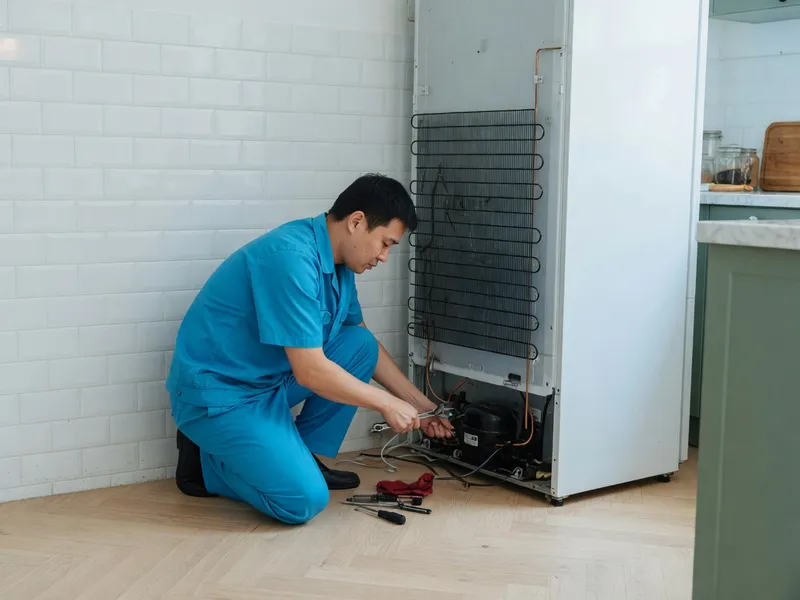
- Condenser coil dust: The top reason for a refrigerator repair visit—dust blocks heat exchange, raising cabinet temperature.
- Evaporator fan failure: A seized fan motor stops cold air from reaching the fridge compartment, even if the freezer seems normal.
- Defrost system fault: A stuck defrost heater causes ice buildup on the evaporator, choking airflow.
- First step to try: Cleaning condenser coils restores cooling and shortens compressor runtime in under 15 minutes—it’s the quickest diagnostic move.
When the compressor or start relay is at fault
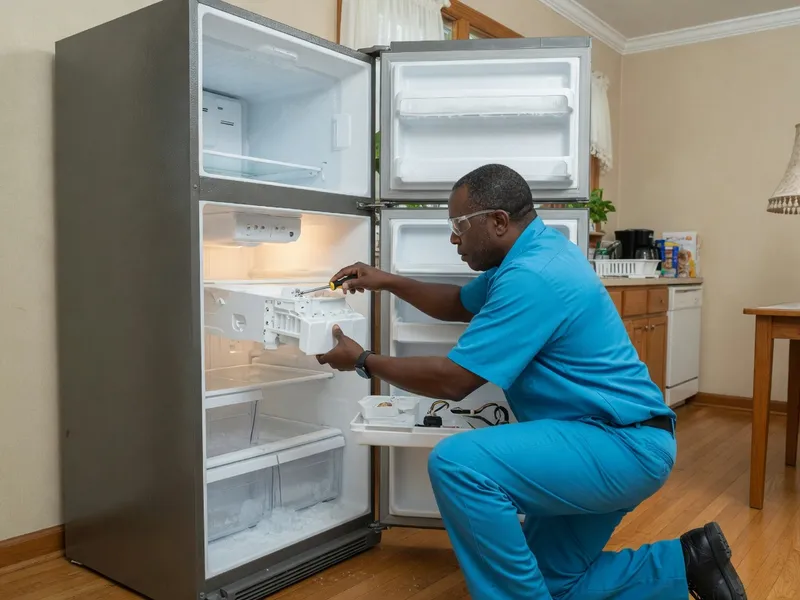
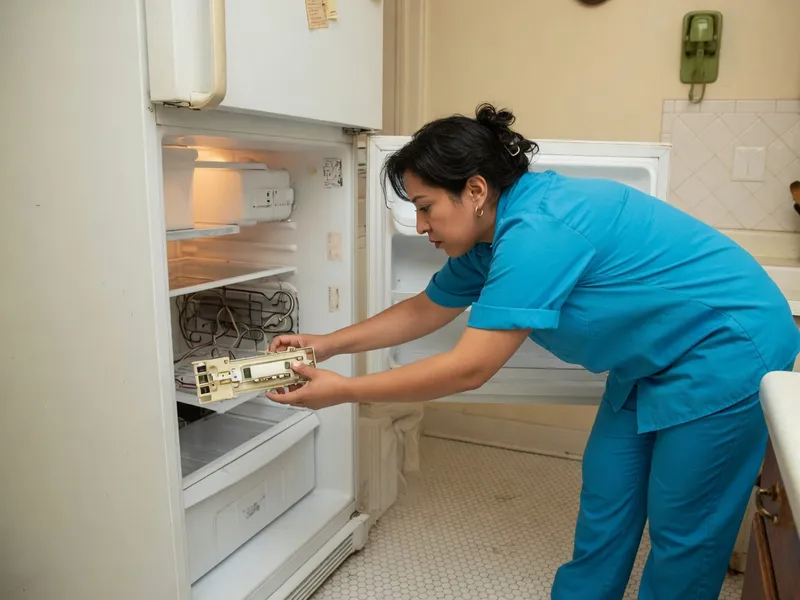
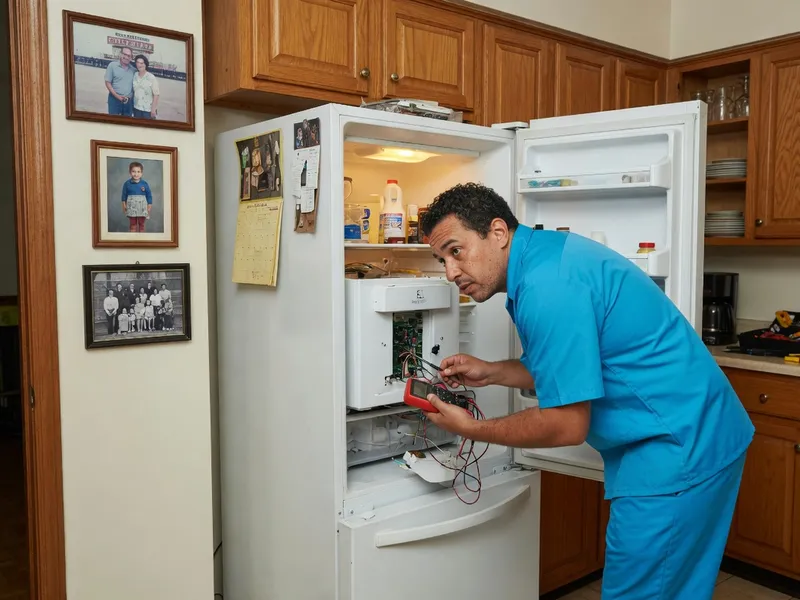
For a refrigerator not cooling, Eco Service NY technicians test the start relay and compressor windings with a multimeter to differentiate between a failed relay and a burnt-out compressor. A click or hum without the compressor kicking on often means the relay has fused contacts, while a completely silent overload points to a seized compressor. We measure winding resistance; a reading outside manufacturer specifications signals internal compressor failure, not just a bad start component. At Eco Service NY, we stock OEM-spec start relays for Samsung, LG, and Sub-Zero, so the repair can be completed same-day. But a $30 start relay swap, in my experience, resolves the issue in about 15 minutes—saving hundreds over a compressor replacement and dodging a misdiagnosis that can run $500 or more.
When Is a Fridge Beyond Repair?
Deciding to retire a refrigerator depends on age, repair cost, and efficiency. Here are the key indicators that it’s time to invest in a new unit rather than keep repairing.
Age: the 10–15 year rule for standard refrigerators
For a standard refrigerator, when to replace refrigerator becomes clear if it’s over 12 years old and needs a repair exceeding $500 — age-related wear often means another failure within a year. At Eco Service NY, we see this pattern a lot — a 13-year-old compressor in a Brooklyn brownstone’s Frigidaire, and the owner’s weighing a $700 repair against a new unit. That same money goes further toward an Energy Star model that runs on R-600a and won’t greet you with a leaking evaporator in six months. In the field, I’ve seen one 14-year-old GE Profile soldier on after a $200 fan motor, but that’s the exception. A 15-year-old fridge can cost $150–$200 more per year in electricity compared to a new Energy Star model, making early replacement pay for itself.
Cost vs. value: when the repair bill exceeds 50% of a new unit
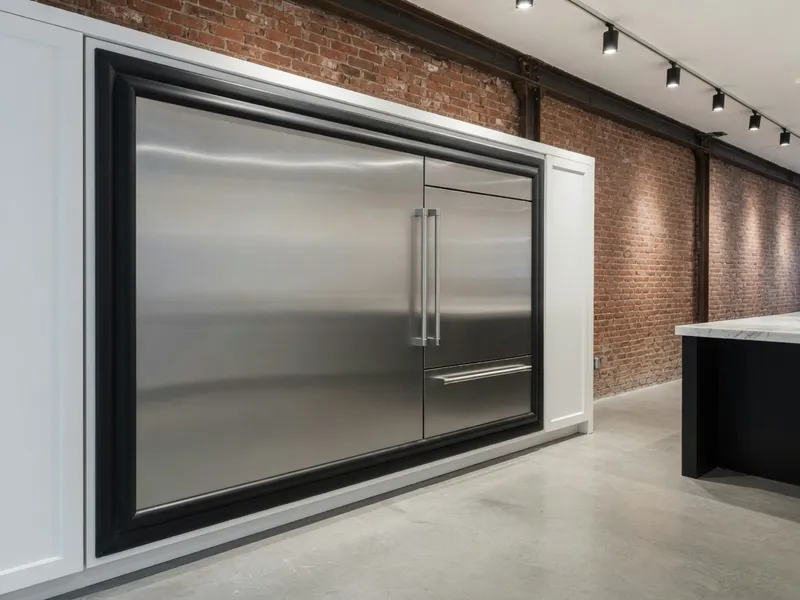
If a repair estimate exceeds half the price of a comparable new refrigerator, replacement is the more cost‑effective choice — especially for mass‑market units under $1,500. In NYC, a compressor swap on a typical LG or Samsung often lands in the $600–$800 range — well over half the price of a new $1,000 model. Even a $400 fan motor replacement on an aging Frigidaire that’s worth $700 at resale edges into dicey territory. Add in the energy penalty of an older unit — easily $100 or more per year — and repair becomes even harder to justify. A $600 compressor job on a $1,000 fridge should be declined, while a $1,200 repair on an $8,000 Sub‑Zero built‑in often still makes financial sense.
Should I repair or replace my refrigerator?
The repair-or-replace decision often hinges on a simple cost comparison but also involves energy savings, downtime, and warranty considerations. Here’s how to weigh the options in NYC.
The 50% rule and how to apply it in NYC
When deciding whether to repair or replace refrigerator, Eco Service gives transparent cost estimates before any work — if the repair is less than half the cost of a new fridge and your unit is under 10 years old, repair usually wins. Our free diagnostic—waived when you book the repair—typically saves a NYC homeowner $50–$150 compared to the industry norm. In my experience, the break-even point in NYC is steeper than the simple 50% rule: an 8.875% sales tax and $50–$100 disposal fee add $150–$300 to the cost of a new fridge, and that tilts many borderline calls toward repair.
Warranty, disposal fees, and hidden costs of buying new
Refrigerator repair cost often seems high, but when you factor in a new unit’s hidden expenses — like delivery, old‑fridge disposal ($50–$100), and the fact most manufacturer warranties exclude labor after 90 days — the scales can tip back to repair. I see too many people overlook disposal fees — it’s $50–$100 just to haul the old unit away. A new fridge in NYC also carries an 8.875% sales tax, pushing the effective price well above the ticket price. And a factory warranty may cover parts but leaves you covering labor costs after just three months. A repair with a 1-year warranty covers both parts and labor, eliminating the gamble of a new appliance’s initial defect period.
Can you repair a refrigerator with a sealed system leak?
A sealed system leak is one of the more complex refrigerator faults, requiring EPA‑608 certification to repair. Here’s how we handle it and what to expect.
How we detect and fix a sealed system leak
When a sealed system leak repair is needed, Eco Service’s EPA‑608 certified technicians locate leaks using electronic sniffers and UV dye, then braze the damaged line with a nitrogen purge to ensure a lasting repair. The technician first connects a manifold gauge set to confirm the pressure drop, then injects UV dye to trace the leak; once spotted—often at an evaporator or condenser brazed joint—dry nitrogen flows through the line during brazing to prevent oxidation scale inside the tubing. We pressure-test the repair to 150 psi for 20 minutes before evacuating and recharging to the manufacturer’s exact ounce spec. At Eco Service, every sealed-system repair comes with a 1-year warranty on parts and labor, so you’re covered if any issue re-emerges. A proper leak repair restores the system’s original charge level, preventing future compressor damage from running low on refrigerant.
Cost, time, and refrigerant considerations
Sealed system repairs cost $400–$1,000 and take roughly 1.5 to 3 hours on-site. In NYC, many repair services charge a $50–$150 diagnostic fee upfront, but choosing a shop that waives the charge when you book the repair saves that amount straight away. Most sealed-system jobs are completed in a single visit without removing the fridge from its enclosure, assuming the leak is accessible. The final bill varies with the leak’s location—an easily reached condenser joint keeps costs at the lower end, while a hidden evaporator inside a built-in cabinet drives the price higher. Newer refrigerators increasingly use R‑600a (isobutane), a flammable refrigerant that demands strict safety protocols during evacuation and recharge—another reason to hire an experienced, certified technician.
How do you ensure energy efficiency after repair?
A proper refrigerator repair should also restore your unit’s efficiency. Here’s what technicians check to keep your electric bill low and the appliance running optimally.
Condenser coil cleaning and door seal inspection
- For an energy efficient refrigerator repair, Eco Service cleans the condenser coils and checks door seals on every call—these steps resolve most post‑repair inefficiency.
- Dirty coils act as insulation, forcing the compressor to work harder; we brush and vacuum them clear in under 15 minutes, restoring proper heat exchange.
- Even a 1‑mm gap in a door gasket adds up to 10% to compressor workload, so a thorough seal test is non‑negotiable.
Thermostat calibration and airflow verification
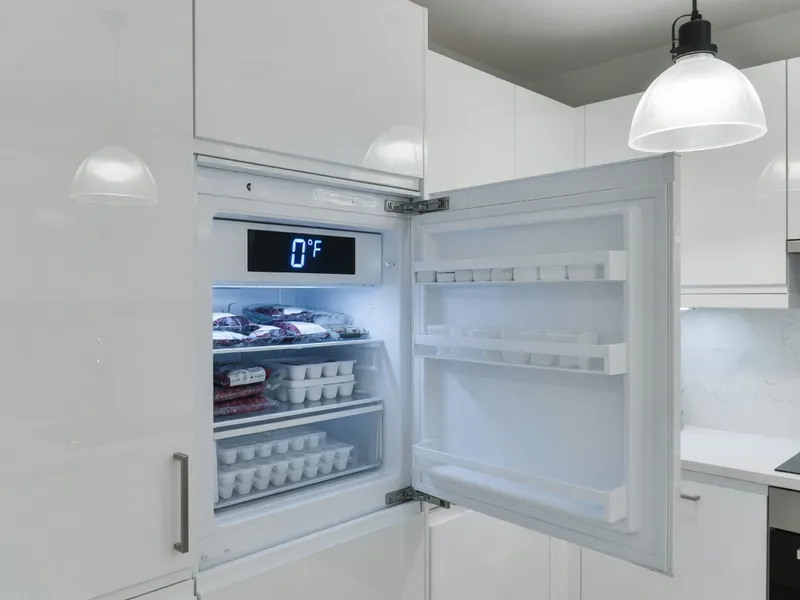
Setting the refrigerator compartment to 37–40°F and the freezer to 0°F, with unobstructed air circulation, can reduce energy waste by 5–10%. Our technicians verify these temperatures with a digital probe and, on models with mechanical controls, adjust the thermostat calibration to match the spec. We also check that the appliance has at least an inch of clearance behind and on both sides—tight installations in Manhattan kitchens often block the condenser airflow, driving up runtime. Inside the cabinet, we inspect the vent openings and confirm no food items are pressed against them; rearranging a few containers can instantly improve cooling and reduce compressor on-time. Blocked interior vents are a common oversight—even after a repair, they can mimic a failed thermostat.
Conclusion
When a refrigerator stops cooling, a handful of guiding principles can clarify whether to repair or replace. These takeaways cover the common failure patterns and the reasoning behind each path.
Main takeaways
- Age and cost guide the repair-or-replace decision: If your refrigerator is over 12 years old and the repair tops $500, replacement often makes more financial sense.
- Common cooling failures have straightforward fixes: Dirty condenser coils, a failed evaporator fan, or a stuck defrost system — the three usual suspects — can be diagnosed and repaired quickly by a trained technician.
- Sealed system leaks are repairable but require expertise: A certified technician can braze the leak and recharge the system, with costs ranging from $400 to above $1,000 depending on the unit.
- Post-repair efficiency checks protect your electric bill: Cleaning coils, verifying door seals, and calibrating the thermostat — these three steps alone — keep the unit from wasting energy, saving you money long-term.